
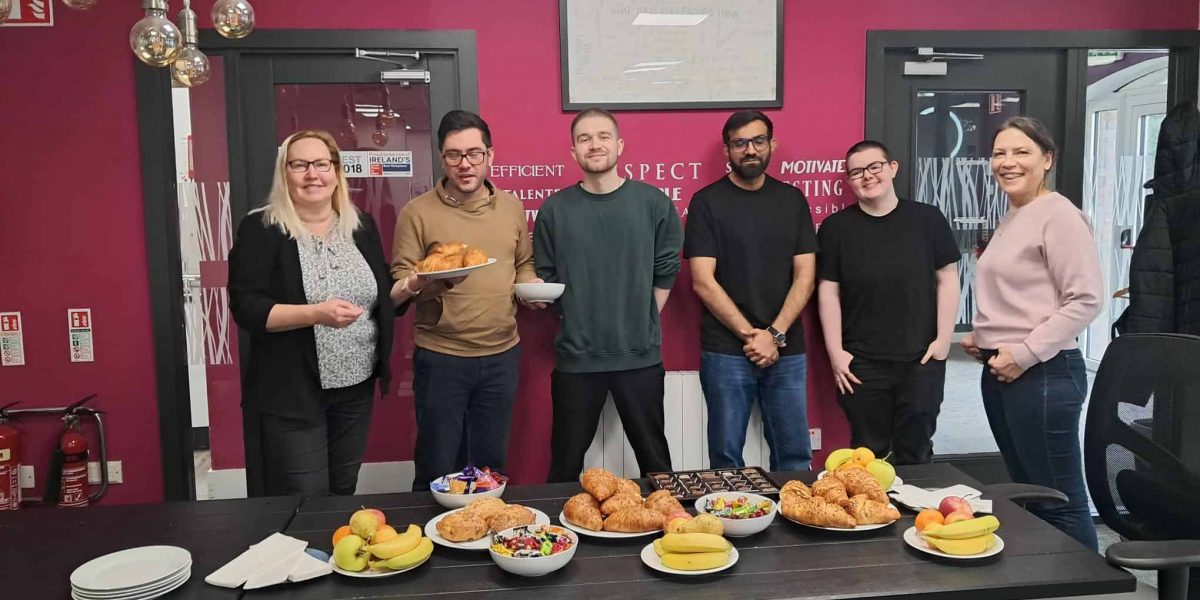
Claire McCooey and Marco Laura started at Propylon on the same Monday in January. Both are computer science students at Trinity College Dublin, and both were beginning eight-month software engineering internships.
Eight months later, with their internships over, we sat down with them to talk about what the placement was actually like. We also spoke to André Gonçalves and Dr. Paul Higgins, two of the senior engineers who mentor our interns, about why we take part in the internship program and what happens behind the scenes.
They arrived with somewhat different amounts of work experience, for Claire, this was the first time working in a company at all, while Marco had one successful internship behind him. This is typical for our internship program: participants come from vastly different backgrounds, interests and experience.
No two internships look quite the same. Interns join different teams, each with its own product, clients and rhythm, and they arrive at different stages: some in third year, some in fourth, some with a previous placement or ambitious hobby projects behind them, others walking into a company for the first time.
This is completely normal, and we designed our program to match this with flexibility. One intern might spend the early weeks on testing and bug fixes the team needs, while another with more experience takes ownership of a larger piece of work sooner. What is constant is the goal: everyone joins as part of a team, not a side project.
“Not just thrown in the deep end”
“In my first internship, I was put on a separate intern project and left to work away on my own. At Propylon, you’re a real member of the team. The tasks are scaled down while you’re learning, so you’re not just thrown in the deep end, but you get real responsibility, and you can see your work going into the product.”
Marco
Meetings out, messages in
The other thing Marco noticed was how open his team was to trying new tools and new ways of working. Compared with his previous internship a year or two earlier, he found Propylon forward-thinking about new technology, including AI, and willing to adapt how the team works.
Halfway through his internship, his team of 10 to 12 people (it shifted as they merged with another team) changed how it ran. “We used to have a fixed weekly meeting and a fairly rigid plan. A few months in, the team decided to cut back on meetings. We’d post updates as messages instead and keep working.” The rhythm became more continuous: fewer ceremonies, more building.
What stayed with him was that the team treated it as an experiment. “It never felt rigid. We tried different approaches to see what worked best for the team.”
Speed Connect
Speed Connect is the flagship event of the internship program run by Trinity’s School of Computer Science and Statistics: one afternoon of back-to-back, 10-minute interviews that pairs students with companies. The internship is a required module on the five-year Master in Computer Science track, taken in the second half of fourth year.
Claire found Propylon through the event’s company list. She looked us up, saw we work in legislative drafting, and put us on her list. Marco remembers Propylon as the only company that had already pulled up his CV and asked him about it, which caught him off guard in a good way. One of the engineers at the table went on to work closely with him. He had also heard good things from a friend of a friend who had interned with us.
On our side, engineers join the recruiting team for the day (two last year, three this year). It’s intense: back-to-back conversations, two students at a time, with the first break after 70 minutes.
Working out what you actually like
Claire started with a very open brief for her own career. “When I joined, I had no idea what I wanted to do. Something with computers, and that was about it.” Because her work spanned the full stack, she got to try a bit of everything and sort what she enjoyed from what she didn’t. She’s now set on front-end development, possibly with some design work. “It’s more visual, and there’s more room for design than in back-end work.”
Marco’s conclusion went the other way. Unlike Claire, he had done an internship before, but in data engineering rather than software engineering. “At university we simulate the work environment, but working alongside experienced professionals is very different. It’s been really encouraging. I’m leaving knowing this is work I enjoy and want to keep doing.”
He hadn’t done much front-end work before and got to try it, but he still enjoyed the back end. What helped was that nobody boxed him in:
“Whenever I said I was interested in a particular area, there was room for me to work on it. I found out I enjoy both, so a full-stack role would suit me.”
Marco
Why we run the program
So why do we run the program at all? There are a few reasons.
It starts with recruitment. Working with Trinity (or: universities in Dublin) puts us in front of some of the best computer science and computer engineering students. Interns who come back after graduating already understand the business, the product and the technology, so onboarding is shorter and they settle in faster.
It also works the other way. Interns bring fresh ideas, research results and the latest development practices from university into the teams. And the senior engineers who mentor them get to develop their own coaching skills. Finally, it puts RWS Propylon’s name in front of students at Trinity, and gives us a way to show them the culture.
It works. In October a former intern started a permanent role with us, joining quality engineering with a plan to move into development. Two others also joined the team earlier, after completing their degrees. And three interns are already confirmed for next year.
Not the new guy for long
Claire and Marco landed in different teams. Claire joined the Government Solutions team, Marco joined the TimeArc team. The ways of working differ a little between teams, but their experiences lined up closely.
Claire had been nervous. “It was my first time in a big professional company, and I worried it would be a bit dull.” She needn’t have been.
“I didn’t feel like the new guy for long. Everyone was so welcoming. We got everything done, but there was plenty of room for fun, and being able to joke around with each other made a big difference to the culture.”
Claire
Marco said the same of his team: “Everyone was super welcoming from the start. People would always make time for me if I had questions.”

From small tickets to full features
Neither was put on a separate intern track. Both started small and took on more as they went.
“At the start, I was working on small, simple tickets to learn the systems and workflows,” Claire said. “By the end, I was building full features, and I wasn’t treated any differently to the other engineers.” So much so that when new people joined her team, they were sent to her for help. “That was a real full-circle moment.”
Was that ramp-up planned? “It might have been, but it felt really organic. I’d finish a feature, and my line manager would hand me something related but a bit more complex, and ask if I could handle it.”
Marco only noticed the pattern looking back. “It felt natural the whole way through. Only towards the end did I realise it was probably by design.” A teammate explained the thinking to him: the early tasks were a way to learn both the workflow and how the application fits together.
“You fix something in one part of the product and learn how it works, then you’re moved somewhere completely different and learn that too. Over time it grows into bigger bugs, then new features, and by the end I was helping redesign one of the front ends. By then you feel like another team member, not the intern.”
Marco
Organic, by design
Both interns suspected their ramp-up was planned. The mentors’ answer: partly.
“Everything is organic at Propylon,” Paul said. Years ago, onboarding started out as sink or swim, then grew piece by piece: a coffee buddy, an introduction to the CEO, and eventually a detailed plan for a new starter’s entire first week. What has stayed from the early days is the principle of giving people as much – and only as much – as they can handle. “If you’re showing aptitude and cranking out tickets, great, here’s a bigger piece of work. We do the same with our interns.”
André’s approach on the New York team is more deliberate than it looks. Interns arrive already knowing industry-standard languages and frameworks from college projects. What’s new to them is the scale and complexity of enterprise software, and working in a team. So for the first two or three weeks, interns join all the team’s meetings with no expectation to report anything. “See how people communicate, see how we work, see how we go through problems or things we don’t know how to do.” After that, they get a couple of tasks in the next sprint.
Small habits make a difference along the way. If an intern stays quiet in stand-ups, André checks in and asks how their ticket is going, because, as he puts it, “communication is way more important than the coding sometimes. The coding, we can get there.”
The team also runs learning sessions: when part of the team builds something difficult, they walk everyone else through the concepts, the decisions and the problems it solves, and celebrate the wins. About two months in, André’s intern ran a session of his own. To take the pressure off tickets, he was also put in charge of the team’s bug queue, with everyone taking work from his board. Seeing the whole team’s work flow through showed him that tickets are just pieces of work, and took away a lot of the stress.
Ownership matters too. One of Paul’s interns started by testing an entire product end to end, without writing any code, working with one of our business analysts to log what needed fixing. Then he fixed it. “He could really say that was his project,” Paul said.
The results show. André’s intern started out shy in big meetings. By the end, he was much better at explaining problems, and at talking about his wins.
Learn the code, not just the shortcut
Propylon’s engineers now have AI coding assistants in their editors. For interns, the mentors are clear about the priority. “You really want them to understand how code works,” Paul said. That puts the weight on code review: when an intern’s code shows they don’t understand how it works, a mentor sits down with them and goes through it. Paul admits he has left some pull requests looking “like a crime scene.”
André frames it as learning to use the tool well. “We don’t expect you to come in and solve everything. We want you to keep developing an understanding of AI as a tool, and apply it well.” Paul sees value in using it to get up to speed on an unfamiliar framework, as long as interns then check that what it gives them makes sense and fits what the team is building.
Same hybrid deal for everyone
Interns worked the same arrangement as their teams. For the Minnesota team, that meant one team day a week, with most people in the office two or three days. A couple of colleagues in Serbia work fully remote. Marco’s team also had one team day, and the interns were encouraged to come in more at the start, which they did.
“I enjoy coming to the office,” Marco said. “It’s good to have some separation from home.” Claire, on reflection: “I wish I’d come into the office more.”
The mentors see the office as part of the learning. New starters spend their first week on site, then join weekly team days, and interns are encouraged to come in as much as they can. Paul and André both try to meet their interns in person once a week. “It’s all the chats that aren’t online where you really learn how an office works and what’s going on in the company,” Paul said. André adds connecting with people from other teams, which builds a sense of community and sparks new ideas. Interns who start together tend to form their own group too, eating lunch together and swapping notes on Dublin culture.
Out of the shell
The internship is mandatory for Trinity computer science students. So why should the next cohort take it seriously?
“Go for it,” Claire said. “It’s foundational experience, and I’m glad Trinity makes it mandatory. It gives you a glimpse of what all the years in college have been building towards, and what working life after the course could look like.”
For her, the bigger change was personal.
“When I started, I was very nervous and very much in my shell. I couldn’t have imagined agreeing to an interview like this one. Now I’m more than happy to, and that says a lot about how welcoming Propylon is.”
Claire
Job hunting next year feels different too. “Now that we’ve been through the process, it’s much less intimidating.” Her CV will get React and Jira, “which a lot of software companies use,” plus something harder to list: “I’m a lot more confident talking to people than when I started.”
Marco’s argument is about what university can’t simulate. “We spend years talking about software engineering in college, but it isn’t the same as doing the job. You learn to work in a team and organise your work. Technically, I feel I learned almost as much in eight months as in all my years at university.”
And for anyone weighing up Propylon specifically:
“Being properly integrated into the team was the big highlight. You’re not an intern put to the side. You’re a junior developer doing real work, and there’s no better way to learn what the job is like and to improve as an engineer.”
Marco
The module that got them ready
Asked what from their degree carried over best, both named the same thing: Trinity’s SwEng Industry Projects. Teams of second- and third-year students build a project for an external company. The second years do most of the development, and the third years get a taste of the management side.
“It’s structured a lot like a professional development team,” Claire said. Propylon is one of the companies that takes part. “I never got to work on the Propylon project, but I always thought it looked really interesting.”
Marco called it one of the most demanding modules of the course, and one of his favourites. “You’re put in a group with people you don’t know and have to learn to work together, with an external client and weekly deadlines where you present your work. It’s great preparation for internships and the workplace.”
Paul has been involved with the module for four years. Each year, Propylon sends Trinity a short project proposal, and the student team has to spec it, scope it and manage the time themselves. They don’t get Propylon’s code, just a brief and a suggested technology stack. “Every time they do a project with us, it’s more amazing,” he said.
What the mentors want them to take away
We asked André and Paul for the one piece of Propylon culture they try to pass on early. André’s answer has two halves: “Be bold in trying to solve things, and rely on your team when you need them. That goes both ways.”
Paul built on it: “There are no lone geniuses. The people who do well here are good communicators.”
After hours
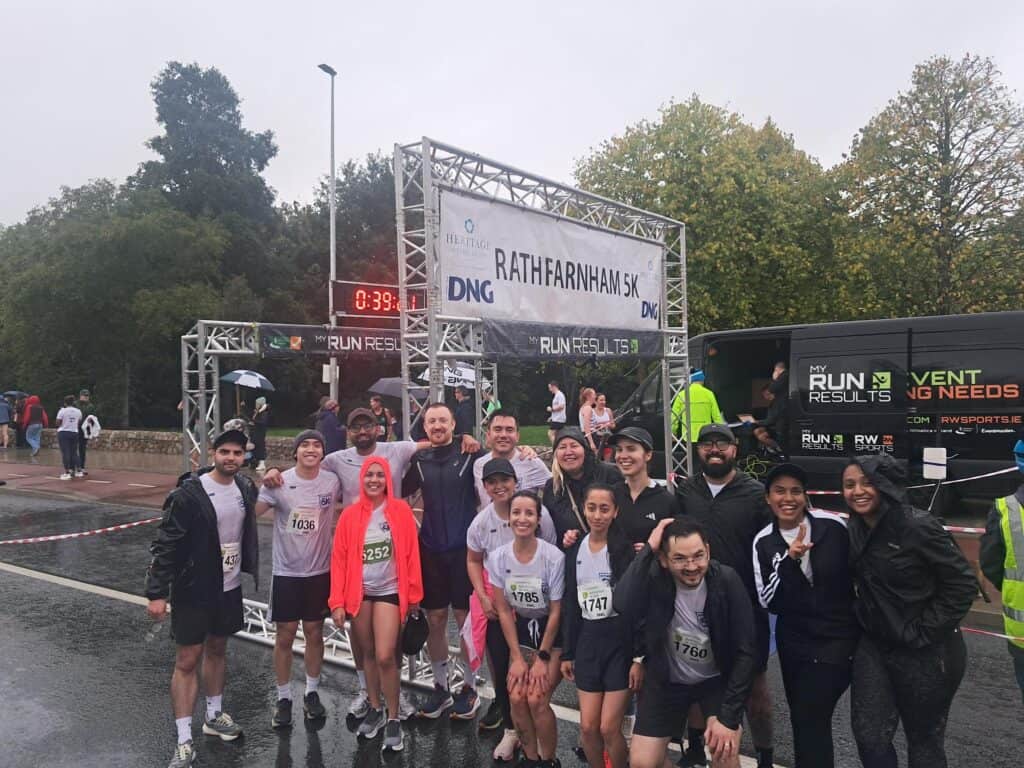
We run plenty of social events; the most recent was a 5K run. We see them as part of how interns settle in: outside the usual office setting, it’s easier to spend time with tech leads and senior engineers, and those conversations carry back into work.
If you’re a Trinity student deciding where to do your internship, you can see more of the internship experience here. And if you get the job: go into the office more than you think you need to. Claire’s orders.